Thursday, November 25, 2010

A Functional Approach

I have learned that there is a more person friendly method to approaching students "bad behaviour". We can take this approach and examine the student based on more than just the behavior. I also learned that there are ABC’s. By using positive behaviour support to fix student’s behaviour can be obtained by providing alternate ways for students to achieve positive behaviour. Strategies that are in the functional approach include teachings desired behaviours, reinforcing good behaviours, Setting up predictable routines, providing frequent opportunities for choice and providing adaptations for academic success.

I much rather prefer this functional method as opposed to operational conditioning. This is a more student friendly method, and will in the long run help the student through their problems. However I find myself using the operational conditioning approach while teaching swimming lessons. This is only due to the fact that I have limited time in my lessons at the most 40 minutes, and I don’t have time to assess the student and prevent these behaviours. I also don’t have time to work with the student after class to talk about the behaviour.

When I am a teacher I will definitely use the functional approach with my students to observe antecedents before they become behaviours, and I have to deal with them in a serious manner. I would like to learn more about student’s behaviours and if there are small actions that can tell me if a child is about to have an outburst, or is internally conflicted. If I was able to know these small verbal or physical cues I could help more kids.



Wednesday, November 10, 2010

Multicultural Education


Socioeconomic status-
                I do not agree with this opinion, theory on student’s success, no matter how many cases that it is true in. I think that if a parent does not have enough money to send their child to school then of course that child might not succeed because of lack of opportunity. My parents are middle class, my mom finished a year of college and my dad barely finished high school. Yet here I am in my second year of college planning to go off to university in the next couple years.               
Cultural capital-
                I think cultural capital is awesome to have in school; it can show the other students a new culture and also provide great style ideas. Cultural capital helps students bring to schools their personality and part of where they grew up.
Reducing barriers-
                I think all kids should have an opportunity to showcase who they are and where they came from.  Teachers should have a positive attitude and help those students show not only their cultures but also their attitudes on aspects of society. Some ideas that I would incorporate would include show and tell, and also ancestor day where all kids brought to school different things to show their ancestry.

Classroom management


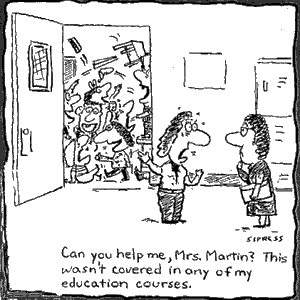
I have seen classroom management done in many different ways. I have teachers who would shut off the lights to gain classroom silence, teachers who would just stand quietly until the class was silent, and those that would just start doing notes forcing us to take out our books and be silent. When a student would act out most teachers would ask them to wait in the hallways and talk to us either after class or halfway through class. Other teachers would send the students directly to the principal which in most cases the student would leave the school and go home.
When I am a teacher I plan to have competitions where the first person with their books out and open gets a star, or a prize, this way every student has the opportunity to succeed. When the children are being rowdy or loud I will ask the ring leader to stand up in class and tell everyone the story they were telling with their friends.

Inclusive Education

I have learned that within the next years ahead inclusive education will become more and more relevant. Our job as teachers will be not only to teach the subject matter but also to transform the way we teach and put in extra time and patience to help teach children with learning disabilities. Included in inclusive education are I.P.P’s which may or may not be abolished by the time I am a teacher, as well funding for the student is required. I will have to make a long term, and short term goals plan for the student with a group of people directly involved with the student.
I come away from this scared and unsure if it is something I will be able to come to terms with in my teaching career. I am strongly hoping that by the end of the teaching program I will be comfortable and able to teach these students effectively.
I am very much so on the fence with inclusive education. Although I agree that every student no matter what there race, ethnicity, gender, or disability should be included in a normal classroom setting. However I feel strongly that these children with learning disabilities should have as much attention and assistance that they need, and depending on the severity of the learning disability they should have as much one on one help as they need. In a public classroom in Alberta every class averages 12-25 students, and if 5 of those students have a learning disability it will be very unlikely that the teacher will be able to give those students extra individual attention to help them through the subject. I think these children need to have an aid either in class or after class to assist them to understand the technology.
I would like to learn how I can teach these children as effectively as possible, in the areas of teaching subject matter as well as discipline techniques, and also as to how to get them the help they need to be successful.
I had a fellow student in middle school with a learning disability; I often got frustrated with that student because she took so long to answer what I thought were simple questions. The teacher would give her extra time and she would leave in the middle of class with other students to go into another room to get extra help. She always bragged about how the helper teacher would give her all the answers to her homework, and they also got to write tests in that other room. She would brag about how the teachers even answered questions on the test for her. But the bragging didn’t last long, eventually she wanted to get out of that special class to prove she wasn’t different. Now she is learning disability free and is attending an arts school for art and design.
Once I have all the techniques I need for dealing with people with learning disabilities I will do my best to be an effective helpful teacher.

Reflection on Ted Leroy's video

I think the video by Ted Leroy was quite insightful. I know working with people with disabilities can be a handful sometimes and this video helped me understand. For example now knowing how they process information I will start to give more time for them to answer my questions. Also that they are processing so much information at one time that it may be hard for them to focus in the classroom.

I learned that they need positive reinforcement to do better, not punishments. The video made me sad when the individuals were asked to read from a passage that was scrambled and on different levels, and hearing them read showed me exactly how disabled people must feel. I take away from this being more respectable of individuals with disabilities, and also more patient. I agree that it is great to have these individuals in class if they are not so disabled that they cannot follow with any concepts or materials in the classroom setting.

I would like to learn more about how to treat people with learning disabilities so that when I am in the classroom I can teach them in a positive and effective manner. At the Roland Michener center where I lifeguard I am involved with guarding the Special Olympics. This is very fun to observe and it is great interacting with the people involved in it. There was an incident a while ago at the pool during Special Olympics where a boy with autism was going over into the fast swimmers lane. This boy could not swim and I had to yell to try and get him to move. The next week my work had brought in a girl that was very experienced in helping people with disabilities and she informed me that loud noises distracted the boy even more, and she offered a alternative way of getting children with that disabilities attention.

If I am to teach a child with a learning disability I will tell him the question before I ask it and let him process the question before I ask for an answer. Also I will go slower in the classroom and give positive reinforcement to those students who get the questions correct. By doing this I will hope to achieve confidence in the learning disabled child.